

The bikes are leaning against the wall, paint cans are collecting dust, and the holiday bins have claimed the only clear floor space. In that moment, the question of garage cabinets vs shelving is not just about storage. It is about whether your garage can support the way your family actually lives.
Both options can reclaim valuable square footage when they are designed around your belongings and installed correctly. The right choice depends on what you store, how often you need it, the look you want, and whether you need a system that keeps visual clutter out of sight. For many households, the best answer is not cabinets or shelving alone. It is a planned combination that gives every item a proper home.
Garage Cabinets vs Shelving: The Core Difference
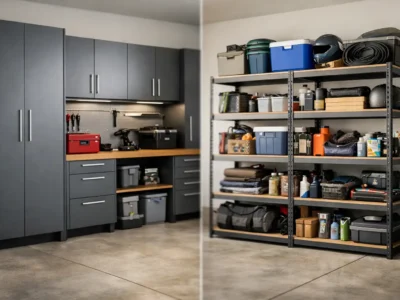
Garage cabinets provide enclosed, finished storage. Their doors hide supplies, protect belongings from dust, and create a cleaner visual line across the room. They are especially effective for homeowners who want their garage to feel like an extension of the home rather than a catchall for equipment and overflow.
Shelving keeps items visible and easy to reach. Heavy-duty shelves are an efficient choice for large bins, bulky tools, coolers, camping equipment, and other items that do not fit neatly inside a cabinet. Because shelves use vertical wall space so effectively, they can hold a significant amount without taking over the floor.
The difference is simple: cabinets prioritize a polished appearance and protected storage, while shelving prioritizes open access and flexible capacity. Neither is automatically better. The better system is the one that matches the items coming into and out of your garage every week.
When Garage Cabinets Are the Better Investment
Cabinets make the strongest case when appearance, containment, and daily convenience matter. A cabinet system replaces mismatched containers and exposed supplies with a consistent, finished look. That visual order can make a busy family garage feel calmer before anyone even starts looking for a soccer ball or drill bit.
They are also well suited to items that should not be left in plain sight. Household chemicals, automotive supplies, paint, power tools, hobby materials, and small accessories are easier to organize behind doors. For families with young children or pets, enclosed storage can add another layer of control by keeping certain items less accessible.
Cabinets work particularly well along a primary garage wall, where they can establish a clean storage zone without crowding the parking area. A cabinet-and-workbench arrangement creates a practical place for home projects, equipment maintenance, gift wrapping, and hobbies. Instead of carrying supplies into the house, homeowners have a dedicated, organized surface where the work happens.
Premium garage cabinetry is designed for the demands of a garage environment, not simply adapted from interior storage. Material quality, hardware, construction, and professional installation all matter when cabinets are expected to hold heavy tools and withstand years of active use. This is why cabinetry is often viewed as a one-time-investment solution for homeowners who want lasting performance and a refined finish.
Cabinets do have limits. Their fixed compartments can be less forgiving for oversized bins or unusually shaped equipment. If your storage needs change often, or if you primarily keep large containers and seasonal gear, an all-cabinet layout may not use the available space as efficiently as a mixed system.
When Heavy-Duty Shelving Makes More Sense
Shelving is built for straightforward access and substantial capacity. It is often the better fit for storage that is large, rugged, or frequently rotated through the seasons. Clear, labeled bins on durable shelving make it easy to see what is available without opening multiple cabinet doors.
Consider the household that stores beach gear in summer, holiday decor in winter, team sports equipment throughout the year, and camping supplies whenever a weekend trip comes up. These categories tend to be bulky, and they benefit from wide, open shelf space. Shelving lets you group them by activity, season, or family member while keeping them off the ground.
Open storage can also make routine organization easier. When an item has a visible, assigned spot, it is more likely to be returned there. That is valuable for families managing helmets, cleats, balls, lawn equipment, and the everyday gear that otherwise accumulates near the entry from the house.
The trade-off is visual. Even neatly labeled bins create a more utilitarian appearance than closed cabinetry. Shelving also calls for a little more discipline. If items are placed randomly, open shelves can quickly look crowded. A professional garage design addresses this by assigning shelf heights and zones based on what you own, not by forcing your belongings into a standard layout.
The Best Garage Storage Systems Use Both
For most active households, the cabinets-versus-shelving decision is not an either-or choice. A well-designed garage often uses each system where it performs best.
Cabinets can hold the smaller, less attractive, or more sensitive items that benefit from protection and concealment. Shelving can handle the oversized bins, coolers, sports totes, and frequently used equipment that need quick access. Overhead racks can reserve upper space for items used only a few times a year, while slatwall keeps rakes, yard tools, folding chairs, and other wall-mounted gear organized at eye level.
This layered approach prevents one category from taking over another. Seasonal bins do not consume valuable cabinet space. Everyday tools are not buried behind stacked containers. Sports equipment does not drift across the floor. Each storage solution carries the type of load it is designed to manage.
A combined layout also creates better traffic flow. The goal is not merely to fit more into the garage. It is to create usable clear space for vehicles, walkways, and the activities that make the garage valuable to your family.
How to Choose Between Cabinets and Shelving
Start with the belongings that create the most frustration today. If the problem is a visible collection of smaller supplies, cleaning products, tools, and hobby materials, cabinetry will likely make the most immediate difference. If the problem is stacks of large totes, camping gear, and seasonal household overflow, shelving may deliver more capacity per wall.
Then consider frequency of use. Items used weekly should be easy to reach without moving other belongings. Items used a few times a year can live higher up or farther back. This is where a thoughtful design outperforms a collection of individual storage pieces. Accessibility is planned rather than left to chance.
It also helps to think about the finish you want. Some homeowners want a clean, coordinated garage that looks as intentional as a finished room. Others care most about quickly locating equipment and maximizing every inch of wall space. Both priorities are valid, but they lead to different storage proportions.
Finally, account for weight and safety. Garage storage is often asked to hold far more than a closet or pantry: loaded bins, power equipment, tools, sporting goods, and household supplies. Storage components must be selected, mounted, and installed for the loads they will carry. Professional design and installation help ensure that capacity, clearances, and accessibility are addressed from the start.
Make the Garage Work Harder for Your Family
A garage should not become the place where useful items disappear until the day you need them. Whether cabinetry, shelving, or a tailored combination is right for your home, the goal is the same: make storage easier to use, safer to manage, and pleasant to see.
Garaginization designs premium garage systems around the real equipment, routines, and space constraints of each household. A free in-home consultation can turn a crowded garage into an organized, finished space that supports everything from weekday practices to weekend projects – with room left over to enjoy it.
 How to Organize a Family Garage Right