

Quick Summary
- Most residential garage ceiling joists are rated for 10–50 lbs. per square foot — and standard big-box overhead racks regularly push right up against (or past) that limit.
- The difference between a safe installation and a catastrophic ceiling collapse comes down to one thing: how, and where, the weight is anchored.
- Garaginization’s commercial-grade, powder-coated steel systems are engineered to distribute load safely across structural members — holding up to 3x more in the same footprint, without putting your vehicles, family, or home at risk.
Your garage ceiling is doing something right now that you’ve probably never thought about.
It’s holding up the weight of your attic — insulation, HVAC ducts, holiday boxes you haven’t touched in three years, and whatever else migrated up there over the past decade. Before you bolt anything else to it, you need to know exactly what you’re working with.
The honest answer most people don’t want to hear: your ceiling’s weight capacity is probably lower than you think, and far more complicated than any big-box rack’s packaging will tell you.
Here’s what the engineering actually looks like — and why getting this right matters more than almost any other home decision you’ll make.
The Number Everyone Searches For (And Why It’s the Wrong Question)
If you searched “garage ceiling joist weight capacity,” you were probably hoping for a single, clean number. Something like: “Your ceiling holds 500 lbs. You’re good.”
That’s not how structural engineering works.
The real answer depends on four variables that are specific to your home:
- Joist type — Are you working with dimensional lumber rafters, engineered I-joists, or roof trusses? Each has a completely different load profile.
- Joist span — The longer the unsupported span between bearing walls, the lower the safe load per linear foot.
- Joist spacing — Standard residential framing uses 16″ or 24″ on-center spacing. Wider spacing means less total load capacity across the ceiling plane.
- Existing dead load — What’s already hanging from or resting on those joists? Drywall, insulation, and HVAC equipment all count against your capacity before you hang a single bin.
In most DFW-area suburban homes built in the last 30 years — the Frisco, Plano, and Southlake neighborhoods we work in most — the garage ceiling framing follows standard Texas residential building codes. That typically means roof trusses designed for a 10 lbs. per square foot (psf) live load, not the structural lumber that can support significantly more.
That distinction is critical. And it’s the first thing our team assesses before a single bolt goes into your ceiling.
Trusses vs. Rafters: Why Your Garage Ceiling Type Changes Everything
Think of your garage ceiling framing the way you’d think about a bridge.
A traditional rafter system — older, dimensional lumber — is like a solid concrete bridge. It’s robust, overbuilt, and forgiving of point loads. A roof truss system is more like a suspension bridge: it’s engineered brilliantly for distributed load, but its internal web members are not designed to carry concentrated hanging weight at arbitrary points.
This is the single most dangerous knowledge gap in the DIY overhead storage world.
Roof Trusses (Most Common in DFW Suburbs)
The majority of homes built in North Texas suburbs since the 1980s use prefabricated roof trusses. These are the triangular wood frames you see when you look up in an unfinished garage.
The critical rule: You must anchor into the top chord of the truss — the horizontal bottom member — and only at specific points. Attaching to the diagonal web members, or between truss bays without proper blocking, can compromise the truss’s engineered load path and void your home’s structural warranty.
Standard residential trusses in Texas are typically designed for:
- 10 psf live load (temporary, moveable weight — like storage boxes)
- 5–10 psf dead load (permanent fixtures — drywall, insulation)
That gives you a combined working capacity of roughly 20 psf in ideal conditions. For a 4×8-foot overhead storage platform, that’s approximately 640 lbs. total — but only if the load is properly distributed and anchored at the right structural points.
Traditional Rafters (Older Homes, Some Custom Builds)
If your home has a traditional rafter system with a ridge beam, you’re working with dimensional lumber that generally carries more load flexibility. These systems can often support 40–50 psf, making them more forgiving for heavy overhead storage.
The catch: older DFW homes with this framing style may also have decades of deferred maintenance — notched joists, previous DIY holes, or pest damage — that has silently degraded their capacity. You can’t evaluate this from the floor.
Live Load vs. Dead Load: The Distinction That Protects Your Vehicles
Here’s the concept that separates a safe installation from a liability.
Dead load is the permanent, static weight attached to your ceiling structure — drywall, insulation, light fixtures, and the storage system hardware itself.
Live load is the variable, movable weight — the bins, tools, holiday decorations, and sporting equipment you’re actually storing.
Building codes treat these differently because they behave differently. A dead load is predictable and constant. A live load shifts, concentrates, and changes over time as you add and remove items.
The dangerous mistake: Most homeowners — and most big-box rack manufacturers — only think about total weight. They see a rack rated for 600 lbs. and assume their ceiling can handle it.
What they don’t account for is how that weight is transferred to the structure. A 600-lb. load distributed evenly across eight anchor points is fundamentally different from the same weight concentrated at two lag bolts driven into drywall between joists.
The second scenario is how ceilings collapse. And in a DFW garage with a luxury vehicle parked underneath, that’s not a hypothetical risk — it’s a real one.
The Hidden Danger of “Good Enough” DIY Installations
We’ve seen the aftermath. A homeowner buys a popular overhead rack from a home improvement store. They follow the instructions, find what they believe are the joists, drive the lag bolts, and load it up.
For six months, it looks fine.
Then one August afternoon — when your Texas attic has been baking at 130°F for three months, and the wood has expanded and contracted through a full season — one anchor pulls. The rack tilts. And 400 lbs. of bins drops onto the hood of a vehicle that took four years to pay off.
The structural risks that DIY installations routinely miss:
- Anchoring into drywall or the drywall-joist interface rather than the joist itself
- Using lag bolts that are too short to achieve proper thread engagement in the wood
- Overloading a single truss bay without distributing weight across multiple structural members
- Ignoring the cumulative dead load already present (drywall + insulation + HVAC) before adding storage weight
- Failing to account for Texas’s extreme thermal cycling, which degrades fastener holding power over time
This isn’t a scare tactic. It’s structural physics. And it’s exactly why commercial-grade overhead garage storage is engineered differently from anything you’ll find on a retail shelf.
What “3x More Storage” Actually Means — The Engineering Behind It
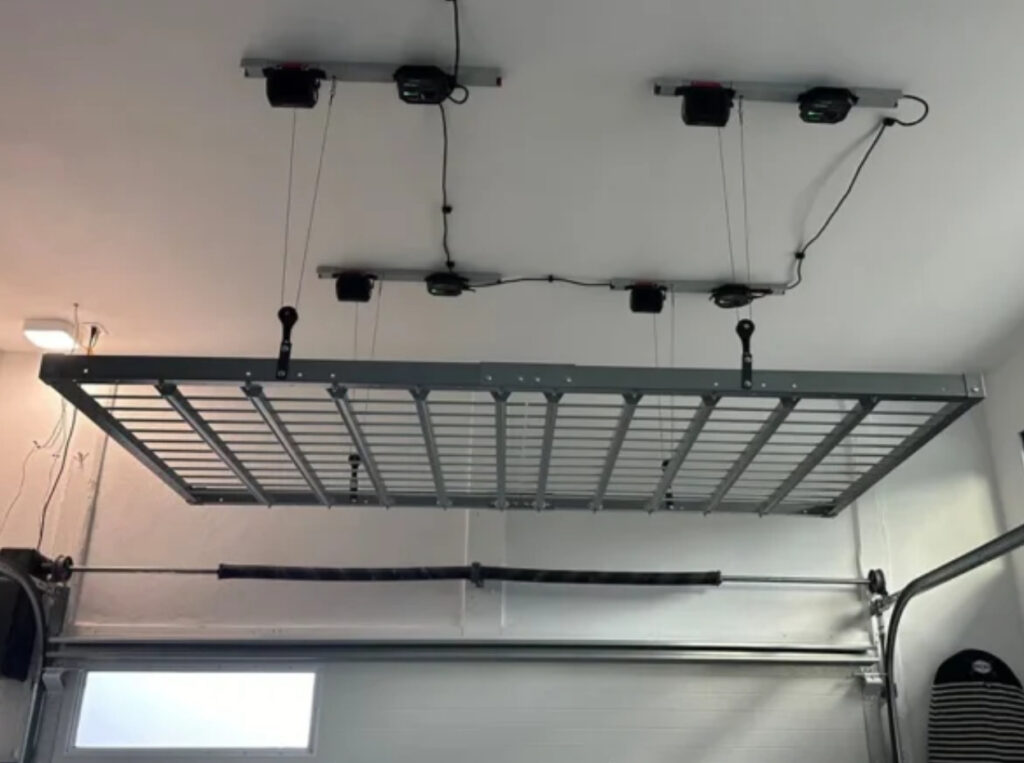
Garaginization’s overhead storage systems are built from powder-coated steel — the same material class used in commercial warehousing — and they’re installed by W2 employees trained to assess your specific ceiling structure before a single anchor goes in.
Here’s what that looks like in practice:
Step 1 — Structural Assessment. Our team identifies your joist type, spacing, span, and existing dead load before recommending any system configuration.
Step 2 — Load Distribution Engineering. Rather than concentrating weight at a few points, our systems use multiple anchor points per bay, spreading the live load across the maximum number of structural members possible.
Step 3 — Proper Hardware. We use commercial-grade lag bolts with the correct diameter and thread engagement depth for your specific joist material — not the hardware that ships in a retail box designed for the lightest possible acceptable use case.
Step 4 — Verified Clearances. Every installation accounts for your ceiling height, door clearances, and vehicle roof lines — so nothing interferes with how you actually use your garage.
The result: a system that safely holds up to 3x more items in the same ceiling footprint compared to standard wire racks, because we’re using the full structural capacity of your ceiling correctly — not guessing at it.
What Can You Actually Store? A Practical Capacity Reference
| Item Category | Typical Weight | Notes |
| Large plastic storage bin (full) | 30–50 lbs. | Holiday decor, seasonal clothing |
| Medium tool bin | 40–70 lbs. | Hand tools, hardware |
| Camping/outdoor gear set | 50–100 lbs. | Tents, sleeping bags, chairs |
| Sporting equipment (full set) | 60–120 lbs. | Golf bags, ski gear, bikes |
| Automotive supplies | 30–60 lbs. | Fluids, cleaning products |
A properly engineered Garaginization overhead system — installed in a standard DFW truss-framed garage — can safely accommodate 600–1,500 lbs. of total live load depending on ceiling configuration, distributed correctly across the structural grid.
That’s enough to move your entire off-site storage unit home. Permanently.
Why DFW Homeowners Face a Unique Set of Structural Challenges
Texas heat is not a minor variable. It’s a structural factor.
Attic temperatures in Frisco, Plano, and Southlake regularly exceed 130–140°F in summer. That thermal load causes wood framing to expand and contract repeatedly across a season. Over time, it degrades the holding power of fasteners that weren’t properly specified for the application.
Additionally, many DFW suburbs saw rapid residential construction during the 1990s and 2000s building booms. Homes built during high-volume construction periods sometimes have framing that was built to code minimums — not to the generous tolerances of custom construction. This makes proper load assessment even more critical before adding any overhead storage.
Our team has worked in thousands of DFW garages since 2008. We know what the framing looks like behind the drywall in a 2002 Frisco build versus a 2015 Southlake custom home. That local knowledge is not something you can replicate with a stud finder and a YouTube video.
The Smart Move: A Professional Structural Assessment Before You Commit
If you’re serious about maximizing your garage ceiling for storage — not just hanging a few light bins, but actually eliminating your monthly storage unit costs — the right first step is a professional evaluation of what your ceiling can safely hold.
This is exactly what we do before every Garaginization installation. We assess the structure, design the system to match its actual capacity, and install it with commercial-grade hardware and methods that protect your home, your vehicles, and your family.
You’ve worked too hard for the house and the cars in that garage to risk either one on a rack that wasn’t engineered for your specific ceiling.
[Schedule a professional structural assessment](internal link) — and let’s figure out exactly what your garage ceiling can do.
Conclusion & Next Steps
Your garage ceiling has real, engineered capacity — and with the right system, it can hold far more than most homeowners realize. The key is understanding your joist type, respecting the difference between live and dead loads, and anchoring to the right structural points with the right hardware.
What it isn’t: a guessing game. And it isn’t a project where “close enough” is an acceptable standard when luxury vehicles and family members are involved.
If you’re ready to cancel your monthly storage unit and bring everything home safely, we’re ready to show you exactly how. Garaginization has been doing this in DFW since 2008, with every system built to outlast the mortgage.
Frequently Asked Questions
How much weight can a garage ceiling joist hold for overhead storage?
It depends on your joist type, span, spacing, and existing dead load. In most DFW-area homes with prefabricated roof trusses — the most common framing in Frisco, Plano, and Southlake — the design live load is typically 10 lbs. per square foot. For a 4×8 storage platform, that translates to roughly 320–640 lbs. of usable capacity, but only when the weight is properly distributed across multiple structural anchor points. A professional assessment is the only reliable way to determine your specific ceiling’s safe working load.
Can overhead garage storage cause the ceiling to collapse?
Yes — if it’s improperly installed. The most common failure points are anchoring into drywall rather than structural joists, using undersized fasteners, concentrating too much weight at too few anchor points, and failing to account for the existing dead load already on the ceiling. A professionally installed, commercially engineered system that distributes load correctly eliminates these risks.
What are the safest overhead garage storage racks?
The safest overhead storage systems are those made from commercial-grade materials — powder-coated steel rather than wire or plastic — and installed by professionals who assess your specific ceiling structure before installation. Systems sold at retail are engineered to a minimum acceptable standard and rely on the homeowner to correctly identify and anchor to structural members, which is where most failures originate. A turnkey, professionally anchored system is the only option that guarantees both capacity and structural safety.
 How do professionals mitigate concrete moisture before installing floor coatings