
Quick Summary
- MDF slatwall is engineered wood made from compressed fibers and resin — and in an unconditioned garage, humidity and heat cause it to absorb moisture, swell, and eventually warp or collapse under load.
- No sealant, paint, or DIY fix permanently solves this. In an unconditioned space, MDF is a ticking clock, not a storage system.
- Powder-coated steel and commercial-grade melamine are the only materials built to survive the real conditions of a Texas garage — and they hold up to 3x more gear in the same footprint, for good.
Your garage slatwall looked great on day one. Clean panels, hooks in place, tools off the floor. Then summer hit.
Now the panels are bowing. A few hooks are pulling loose. That heavy bag of golf clubs you hung six months ago is slowly migrating toward the floor. And you’re standing there wondering — did I buy the wrong thing, or did I install it wrong?
You bought the wrong thing. And it’s not your fault — it’s the material.
MDF Behaves Like a Sponge. Your Garage Feeds It.
MDF stands for Medium Density Fiberboard. It’s manufactured by breaking wood down into fine fibers, mixing those fibers with resin binders, and compressing the whole thing under high heat and pressure into flat panels.
That process creates a smooth, uniform surface that’s easy to paint, cut, and hang. It’s also why MDF is everywhere — it’s cheap to produce and looks decent out of the box.
Here’s the problem: those compressed wood fibers never stop wanting to absorb moisture. The resin binders hold things together when conditions are stable, but the moment humidity enters the equation, the fibers start pulling in water vapor from the surrounding air.
Think of it like a compressed sponge. Squeeze a sponge flat, let it dry, and it holds its shape. Introduce moisture and it expands — unevenly, unpredictably, and permanently.
That’s your slatwall.
What an Unconditioned Garage Actually Does to MDF
Most garages in the Dallas-Fort Worth area and across the South are unconditioned spaces. No HVAC. No humidity control. Just whatever the Texas atmosphere decides to throw at them on any given day.
In summer, that means interior garage temperatures routinely hit 120–140°F with humidity levels that spike and crash depending on whether it rained last night or the AC on the house is running overtime. In winter, you get the opposite — cold, dry air followed by warm fronts that bring moisture back in fast.
Each cycle of humidity absorption and drying causes the fibers to expand and contract. The resin binders weaken. The structural integrity of the panel degrades. And because slatwall panels are horizontal — designed to hold weight outward from the wall — that degradation shows up fast as a visible sag or bow in the middle of the panel.
Add a set of heavy tools, a mean, or a 50-pound gear bag, and you’re accelerating that timeline significantly.
The Weight Problem Nobody Talks About
Retail MDF slatwall is typically rated to hold 25–50 lbs per linear foot under ideal conditions. Ideal conditions means a climate-controlled interior space with stable humidity.
Your garage is not that space.
Once moisture begins breaking down the resin binders in the panel, that load rating becomes fiction. The panel isn’t carrying 40 lbs anymore — it’s carrying 40 lbs while structurally compromised. That’s when hooks start pulling out of the slatwall grooves. That’s when panels separate from the wall. That’s when expensive tools end up on the floor.
The failure isn’t sudden. It’s gradual, invisible, and then catastrophic.
“Can’t I Just Seal It or Paint It?”
This is the most common question, and the honest answer is: you can slow the process, but you cannot stop it.
Exterior-grade paint and polyurethane create a moisture barrier on the surface of the panel. But MDF isn’t just absorbing moisture through its face — it absorbs through every exposed edge, every cut groove, every hook hole drilled into it. In a slatwall panel, that’s hundreds of penetration points.
Sealing MDF in a garage is like waterproofing a boat by painting only the hull above the waterline. It looks like you did something. The water still gets in.
Beyond that, sealants crack over time when panels expand and contract through heat cycles. Once the seal breaks, the moisture absorption accelerates — and now you’re back where you started, except with a painted panel that’s warping.
DIY fixes buy you months. They don’t buy you a garage.
What Actually Survives an Unconditioned Garage
Here’s where the material science gets interesting — and where the decision gets simple.
Powder-coated steel has no wood fibers, no resin binders, and no cellulose to absorb water vapor. It doesn’t swell. It doesn’t contract. A temperature swing from 40°F to 130°F doesn’t change its structural integrity or its load-bearing capacity. The powder coating itself creates a corrosion-resistant barrier that holds up to humidity, oil mist, and the kind of abuse a working garage produces every weekend.
Commercial-grade melamine cabinetry is a similar story. Unlike raw MDF, commercial melamine uses a thermally fused laminate surface that seals the substrate completely — including edges — against moisture intrusion. It’s the same material used in commercial kitchens and industrial storage environments for exactly this reason.
The difference in real-world performance isn’t subtle. Garaginization’s powder-coated steel slatwall systems are engineered to hold up to 3x more gear in the same wall footprint as a retail MDF panel — and they do it without bowing, warping, or degrading when your garage hits 130°F in July.
That’s not a marketing claim. That’s what happens when you build something for the environment it actually lives in.
The Real Cost of “Affordable” Slatwall
Let’s talk numbers for a second, because this is where the math gets uncomfortable for the MDF side of the argument.
A standard retail MDF slatwall installation for a two-car garage runs roughly $400–$900 in materials, plus your time. In an unconditioned Texas garage, most homeowners report visible warping within 12–24 months. Some see it sooner.
Now factor in replacement: new panels, new hardware, new installation time. Do that twice over 5 years and you’ve spent $1,000–$1,800 on a storage system that never worked the way you needed it to — and you still have a garage that isn’t organized the way you want it.
A Garaginization turnkey installation costs more upfront. It also costs once. No replacement cycles. No degradation. No Saturday spent ripping warped panels off the wall and starting over.
The homeowners who call us most often aren’t the ones who skipped storage entirely. They’re the ones who tried the cheap version first.
The Upgrade Path: What “Do It Right, Do It Once” Looks Like
If your MDF slatwall is already warping, the repair window is closed. You’re past the point of sealants and touch-ups. The right move is to remove the panels, assess the wall behind them for any moisture damage, and start fresh with a system designed for your actual garage environment.
If you’re still in the planning stage — researching before you buy — consider this your field report from 18+ years of garage installations across DFW. We have never once removed a well-installed powder-coated steel system because it warped. We have removed hundreds of MDF panels that did.
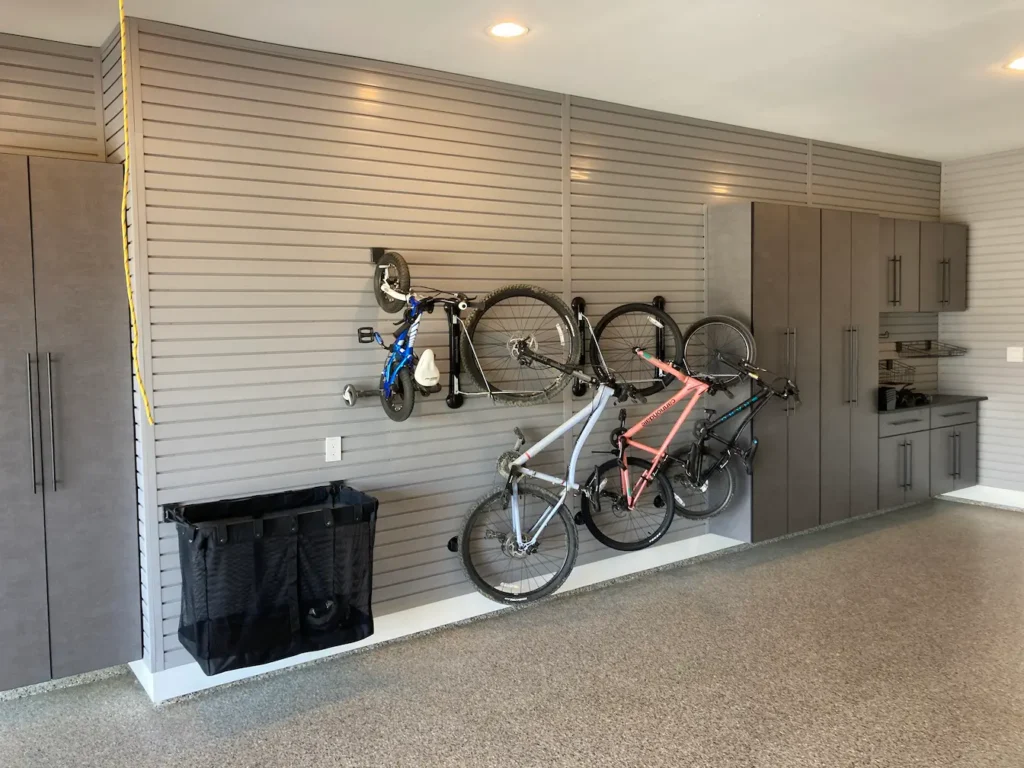
A properly designed Garaginization system doesn’t just solve the warping problem. It reclaims the full capacity of your garage wall — organizing sports gear, tools, bikes, and seasonal equipment in a layout that uses every inch efficiently and holds everything securely, regardless of what the Texas weather does outside.
Conclusion: Stop Treating Your Garage Like a Temporary Problem
Your garage is part of your home. It affects your daily routine, your property value, and frankly, how you feel when you pull in after a long day. A warped, sagging slatwall covered in tools that are slowly migrating to the floor isn’t a minor inconvenience — it’s a system that failed you.
MDF failed because it was never engineered for the environment you put it in. That’s not a fixable flaw. It’s a fundamental material mismatch.
The good news: the right materials exist, they’re available, and a turnkey installation means you never have to think about this problem again.
Do it right. Do it once. Get your garage back.
Frequently Asked Questions
Is MDF slatwall safe for unheated or unconditioned garages?
No — MDF is not suitable for unconditioned garage environments. Its compressed wood fiber construction absorbs ambient moisture from the air, causing the panels to swell, bow, and lose structural integrity over time. In climates with high humidity or significant temperature swings (like most of Texas), this process accelerates rapidly. MDF slatwall in an unconditioned space is a temporary solution at best.
What is the best garage wall storage material for humid climates?
Powder-coated steel is the top-performing material for humid, unconditioned garages. It contains no wood fibers or resin binders to absorb moisture, maintains its structural load rating regardless of temperature swings, and resists corrosion through the powder coating process. Commercial-grade melamine cabinetry — with thermally fused laminate edges — is the second-best option for enclosed storage in humid environments
How much weight can MDF slatwall hold before warping?
Retail MDF slatwall is typically rated at 25–50 lbs per linear foot under controlled, climate-stable conditions. In an unconditioned garage, that rating degrades as moisture weakens the resin binders inside the panel. Heavy loads — tools, bikes, gear bags — accelerate visible warping. Once moisture damage begins, no hook or fastener can restore the panel’s original load-bearing capacity.
 How Much Weight Can Your Garage Ceiling Actually Hold? (The Engineering Answer DFW Homeowners Need)