

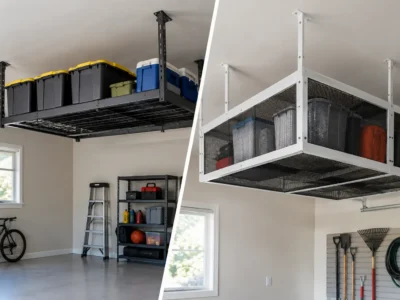
A crowded garage often has plenty of unused square footage – it is simply above eye level. This overhead storage comparison looks beyond the promise of “more space” to help homeowners choose a system that fits their belongings, ceiling height, daily routines, and safety expectations. The right solution can move seasonal overflow out of the way while keeping the items your family uses every week within easy reach.
For most established households, overhead storage is not meant to hold everything. It is a strategic part of a complete garage organization plan. When it is professionally designed alongside cabinets, shelving, slatwall, and work areas, it helps create the clean, finished garage that makes daily life easier.
Overhead Storage Comparison: Start With Access
The biggest difference between overhead storage options is not appearance. It is access. Before comparing load capacity or materials, consider how often each item needs to come down.
Fixed ceiling-mounted racks work best for items used occasionally: holiday decorations, camping bins, luggage, keepsakes, seasonal clothing, and household bulk supplies. They keep storage elevated and visible from below, yet they still require a ladder for loading and retrieval. That makes them an excellent choice for long-term or seasonal categories, not for equipment a child needs to access before practice.
Motorized storage lifts bring stored items down to a comfortable working height. This option can be valuable for heavier bins, bulky gear, or households that want to reduce ladder use. The trade-off is that a lift needs clear space beneath it to travel safely. It also adds mechanical components and typically represents a higher investment than a fixed rack.
Ceiling-mounted cabinets offer an enclosed, furniture-like look, but they are not the right answer for every garage. Their access can be less convenient than open racks, especially for oversized totes, and their capacity depends heavily on how the cabinet is mounted and constructed. They are often best for lighter, neatly contained items when a more polished visual finish is the priority.
The best choice depends on what you store and how frequently you need it. A family that pulls out coolers and folding chairs every month may benefit from a different approach than a household storing holiday bins twice a year.
Fixed Racks: The High-Capacity Workhorse
Professionally installed overhead racks are the most common answer for reclaiming unused garage volume. They use the ceiling plane to create a dedicated storage zone above vehicles, walkways, or less active areas of the room.
Quality racks are typically constructed with heavy-duty steel and designed to support substantial, evenly distributed weight. That strength matters, but capacity alone should not decide the purchase. A rack can be rated for significant weight and still be poorly suited to your garage if it blocks lighting, conflicts with ceiling features, creates a clearance issue, or encourages overloading with mismatched items.
A well-designed rack system should be sized around the storage containers you intend to use. Consistent bins make better use of the available footprint, look more organized, and make it easier to identify what is stored above. They also help prevent loose or unstable items from becoming difficult to handle overhead.
Fixed racks deliver strong value when your goal is to store a high volume of seasonal belongings. They require very little ongoing maintenance and provide an efficient, long-lasting home for items that would otherwise consume valuable floor space. Their primary limitation is simple: retrieval requires safe ladder access and should not be treated as a daily convenience.
When fixed racks make the most sense
Choose fixed overhead racks when you have a collection of durable, containerized items that are used a few times a year. They are particularly effective for holiday décor, camping totes, archived household items, extra paper goods, and out-of-season sports equipment.
They are less appropriate for loose tools, fragile objects, frequently used gear, or items that create an awkward lifting situation. Those categories are generally better placed in cabinets, wall systems, or accessible shelving at ground level.
Motorized Lifts: Better Accessibility for Heavy Storage
A motorized lift is designed around a different need: bringing overhead storage to you. Rather than carrying bins up and down a ladder, the platform lowers for loading and unloading, then returns to its stored position near the ceiling.
For homeowners who want a more accessible solution for heavy or awkward categories, that convenience can be meaningful. It can also support safer use for households where climbing and lifting overhead are not ideal. Sports gear, large storage totes, outdoor equipment, and seasonal supplies can be managed without repeated ladder trips.
However, a lift is not automatically superior to a rack. It requires thoughtful placement. The area beneath the platform must remain available when you need to lower it, which may affect where vehicles park or where a workbench belongs. Homeowners should also account for the system’s operating mechanism, electrical needs where applicable, and the value of professional installation that verifies secure mounting and proper operation.
A motorized lift is best viewed as an accessibility upgrade. If your stored items are light and rarely used, a fixed rack may provide more practical value. If lifting and ladder use are a regular frustration, a lift may justify the additional investment.
Overhead Cabinets: A Finished Look With Specific Limits
Overhead cabinets appeal to homeowners who want storage to look more like part of a finished room. Doors conceal visual clutter, and coordinated cabinetry can create a refined, cohesive appearance across the garage.
Their main advantage is aesthetic control. They can protect lighter supplies from dust and keep less attractive items out of sight. Yet enclosed storage comes with limits. Cabinet dimensions can restrict large bins, doors need clearance to open, and the system must be engineered for the load it carries. Not every ceiling or wall area is an ideal location for overhead cabinetry.
For that reason, overhead cabinets tend to work best as part of a broader custom storage design rather than as the sole answer to garage overflow. Pairing them with high-capacity racks and base cabinets creates a more balanced system: concealed storage for smaller items, elevated storage for seasonal bins, and easy-access storage for everyday essentials.
Capacity Is More Than a Weight Rating
Homeowners often ask, “How much weight can it hold?” It is the right question, but not the only one. Safe overhead storage depends on the complete system: the mounting surface, hardware, rack construction, load distribution, installation quality, and the condition of the items being stored.
A professional design should consider the intended load before anything is installed. Heavy bins should be distributed rather than concentrated in one corner. Items should fit fully within the storage area without overhang. Loose, sharp, leaking, or fragile items should not be placed overhead. And the system should remain clear of anything that needs routine access or service.
Ceiling height matters, too. In a garage with generous vertical clearance, a lower-hanging rack may be easier to use while still maintaining comfortable space below. In a garage with limited height, storage must be positioned carefully so it does not make the room feel compressed or interfere with vehicle clearance.
How Overhead Storage Fits a Complete Garage Plan
The most efficient garages use each zone for its natural purpose. Overhead storage is for seasonal and lower-frequency items. Cabinets are for tools, supplies, and valuables that benefit from protection. Slatwall keeps sports equipment, garden tools, and grab-and-go accessories visible and accessible. Heavy-duty shelving supports larger items that should remain at a manageable height.
This zoning approach prevents a common mistake: placing every category overhead simply because there is open ceiling space. The result may look tidy at first, but it can become frustrating when a frequently used item is stored in the least convenient location.
A custom consultation helps establish what belongs where. A trained designer can measure the garage, account for ceiling features and vehicle locations, and create a plan that gives each category a logical home. Professional installers then ensure that the system is secure, aligned, and ready for the demands of real family life.
The Better Question to Ask Before You Buy
Instead of asking which overhead option is best, ask which items deserve to be overhead. That question leads to smarter decisions about rack size, placement, capacity, and access. It also protects the floor space that makes a garage more useful for parking, projects, hobbies, and active family routines.
Garaginization designs professionally installed garage systems around how your household actually lives. A free in-home consultation can turn that unused ceiling area into purposeful storage – while keeping the things you need most close at hand.
 Dallas Custom Garage Design That Works Harder