
If your garage cabinet doors stopped closing cleanly, or you noticed a shelf starting to bow under a load it handled fine the first year, the cabinet is not defective. It was never designed for where you put it.
That distinction matters. Retail garage cabinets, the systems sold by Husky, NewAge, Gladiator, and their category peers, are built and tested to interior climate standards. They are engineered for the conditions inside a home: stable temperatures, controlled humidity, and the kind of environment where a wood-composite substrate performs exactly as intended. A DFW garage is not that environment. Not even close.
Understanding why that mismatch happens, and what construction actually engineered for the garage looks like, is what this article covers.
The Climate Reality of a DFW Garage
Most homeowners think of their garage as “inside.” It has walls, a roof, and a door. But from a materials science perspective, an unconditioned garage is closer to the outdoors than it is to the interior of your home.
What “Unconditioned Space” Actually Means for Your Storage
An unconditioned space has no active heating or cooling. Temperature and humidity are entirely at the mercy of what’s happening outside, and in the Dallas-Fort Worth metro, what’s happening outside is extreme.
DFW averages more than 60 days per year above 100°F. Summer garage temperatures routinely reach 110°F to 115°F when the door stays closed, and solar heat builds through the afternoon. Winter brings its own swings: North Texas can drop to 18°F to 22°F during hard freezes, as residents learned in February 2021. The National Weather Service’s DFW climate records show annual humidity swings that run from roughly 20% relative humidity during dry winter stretches to 80% or higher during spring storm season.
That is a 90-point swing in relative humidity and a potential 90°F to 95°F swing in temperature across a single calendar year. No retail cabinet substrate is rated for that range. Most are not rated for even half of it.
Why MDF and Particleboard Fail: The Material Science
Walk through a big-box store and read the cabinet specs. Most retail garage storage is constructed from medium-density fiberboard (MDF) or particleboard cores, sometimes with a thermofoil or melamine surface. These are legitimate, well-performing materials in the right environment.
IKEA kitchen cabinets are largely MDF. They last decades. The difference is that IKEA kitchen cabinets live in a conditioned space maintained at 68°F to 72°F and 35% to 50% relative humidity year-round. That is exactly what MDF is engineered for. It is not engineered for what a DFW garage puts it through.
What Humidity Cycling Does to a Cabinet Over 24 Months
Wood-composite materials like MDF and particleboard expand when they absorb moisture and contract when they dry out. Purdue University Extension research on wood and moisture behavior documents this clearly: repeated cycles of expansion and contraction, what materials scientists call moisture cycling, progressively weaken the fiber bonds inside these substrates. Each cycle does incremental damage. The material does not return fully to its original dimension when it dries. Over time, that dimensional change accumulates.
In a DFW garage, a cabinet goes through this cycle not once or twice but dozens of times across a year. A spring rainstorm followed by a dry summer stretch. A cool, humid October followed by a dry January. Each transition is a stress event on the substrate. By the second or third year, the cumulative effect becomes visible: doors that once closed flush now bind or hang crooked, drawer faces that gapped cleanly now rub, and shelving that held weight without deflection begins to sag at the midpoint.
This is not the cabinet failing. This is the cabinet performing exactly as its material specification predicts in an environment it was never designed for.
The Problem with Wall-Hung Rail Systems
Conventional wisdom in the garage storage category says: if you want something more durable than MDF, buy metal. Powder-coated steel rails. Aluminum frames. The metal cabinets from NewAge, Gladiator, or similar brands.
The metal argument has merit on the surface material. Steel does not absorb moisture the way MDF does. But the material is not where wall-hung rail systems fail.
What Happens to the Anchor Points Over Time
Wall-hung rail systems distribute the weight of their cabinet load, often several hundred pounds at full capacity, across a small number of anchor points. A standard 6- to 8-foot rail section typically fastens at 4 to 6 points, driven into wall studs or, in older DFW homes, into drywall with toggle hardware.
Here is what 18 years of in-field observation confirms: steel expands and contracts with temperature, just like any other material. A garage that swings 90°F across the year subjects every metal fastener, bracket, and rail section to repeated thermal movement. That movement is small per cycle, fractions of a millimeter, but across hundreds of cycles, it creates micro-movement at the anchor points. Hardware that was torqued tight on installation day gradually works loose. The rail shifts. The gap between the cabinet bottom and the floor grows. In worst-case scenarios, an anchor pulls partially free from the stud, and the entire loaded system is now hanging at a compromised connection.
The steel cabinet survived. The installation methodology failed.
This is why the material conversation is secondary. Construction method, specifically how a system is anchored and how load is distributed, is what determines whether a garage cabinet system lasts.
What Actually Survives the Garage Environment
A cabinet system engineered for an unconditioned garage solves two problems simultaneously: the substrate must be built to tolerate the temperature and humidity range, and the structural design must distribute load in a way that does not depend on a handful of wall anchors.
Full-Back Construction vs. Open-Back Frameless
Most retail cabinets, including the majority of rail-hung metal systems, are open-back or frameless on the rear. The cabinet box has sides, a top, a bottom, and doors, but the back is either absent or nominal. Load is borne primarily by the sides and the mounting hardware.
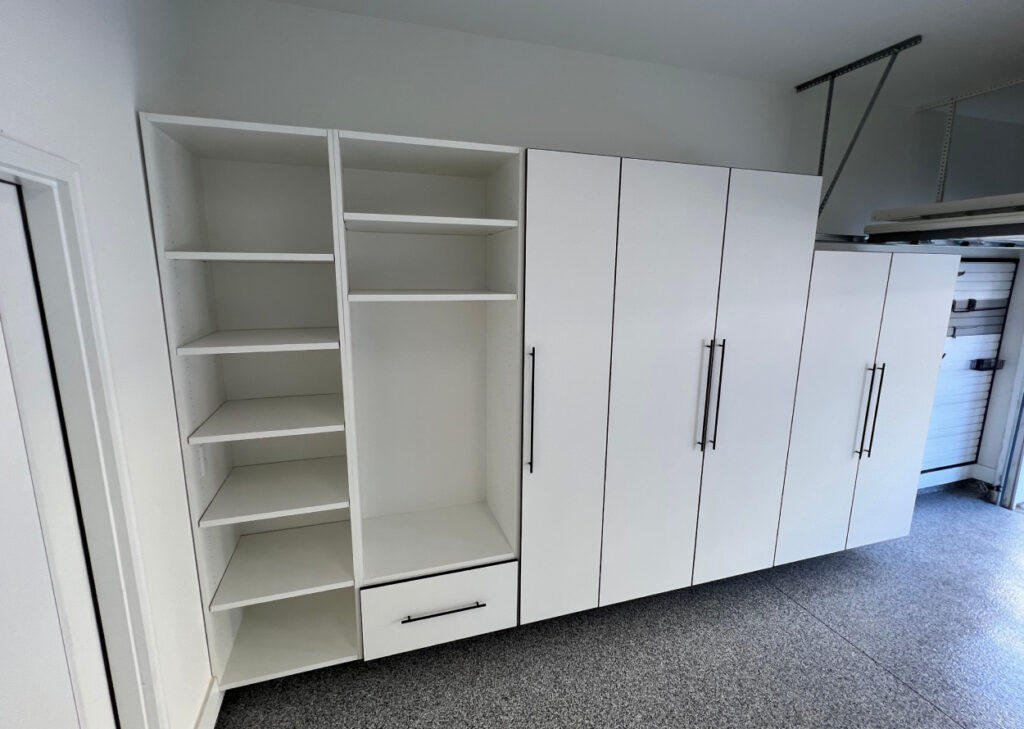
Full-back construction changes the structural equation entirely. A cabinet built with a complete back panel distributes load across the entire rear surface, transfers force evenly to the wall, and adds torsional rigidity that keeps the cabinet square under load and temperature stress. When that full-back cabinet is also floor-anchored, touching the floor and secured to the wall at the full panel, the load is no longer concentrated at 4 to 6 anchor points. It is spread across the entire footprint of the installation.
| Retail / Interior-Rated | Professional / Garage-Rated | |
| Core Substrate | MDF / Particleboard | Industrial-grade composite or steel |
| Humidity Response | Expands/contracts with cycles | Engineered for a wide RH range |
| Temperature Range | Rated for conditioned interiors | Designed for unconditioned environments |
| Back Construction | Open-back or nominal back panel | Full-back panel, load-distributing |
| Mounting Method | Rail-hung, 4–6 anchor points | Floor-anchored, full-back contact |
| Load Capacity | Rated for interior storage conditions | Rated for garage-weight loads |
| Warranty | Limited; typically 1–3 years | Lifetime warranty on shelving systems |
If you are reading this because you already have a retail system that has started to fail, the path forward is straightforward. We have been removing and replacing exactly these systems for DFW homeowners since 2008. There is no judgment in that process, only a clear assessment of what you have, what you need, and what a permanent solution looks like for your specific garage.
[Start with a 3D design, no obligation, and you will see your new garage before a single board is cut.]
The Permanent Solution
A Garaginization installation, whether through the Classic Series or the Signature Series, begins from a different design premise than anything sold at retail.
The Classic Series is the accessible entry point into a system built to the same construction standards as the full Signature line: garage-rated substrate, full-back construction, floor-anchored installation, and hardware that closes the same way on installation day as it does a decade later. It is not positioned as an alternative to big-box retail. It is better than big-box retail. That difference is structural, not cosmetic.
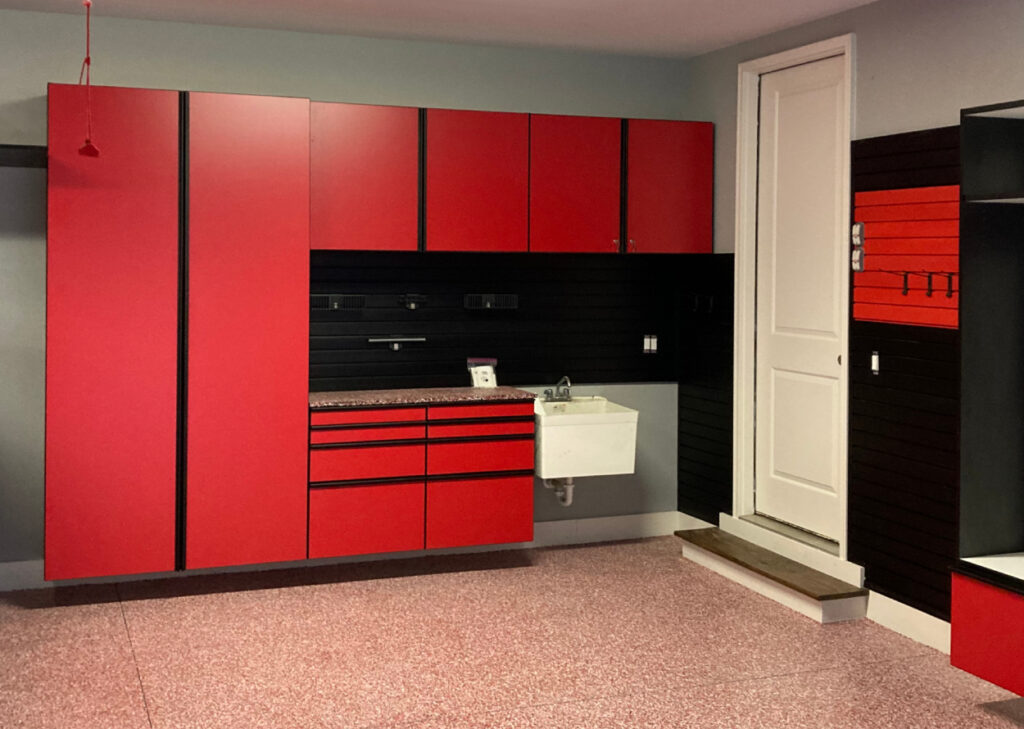
The Signature Series is the full Garaginization experience: custom sizing to your exact wall dimensions, the widest finish range available, premium soft-close hardware, and the craftsmanship that comes from a team that designs, manufactures, and installs every project in-house. No subcontractors. Every installer is a W2 employee trained to Garaginization standards. That continuity, from the 3D design consultation through the final install, is what “end-to-end accountability” means in practice.
Both series are backed by a lifetime warranty on shelving systems. When Jon Lee says a system is built to outlast the mortgage, that warranty is the commitment behind the phrase, not a marketing line.
Serving DFW homeowners since 2008, with an A+ BBB rating maintained across more than a decade of installations. That tenure represents thousands of garages. It also represents thousands of conversations with homeowners who spent real money on a retail system that the DFW climate simply consumed.
The answer was never a better big-box cabinet. The answer was always a system built for the environment it actually lives in.
Schedule Your Professional Garage Design Consultation
If your current system is showing signs of warping, sagging, or loose hardware, or if you are planning a garage you want to do once and do right, the first step is a 3D design consultation. You will see your finished garage in a rendering before anything is built, which means no surprises, no scope creep, and a result you have already approved before installation begins.
Schedule your free 3D design consultation.
Frequently Asked Questions
Can any retail garage cabinets survive an unconditioned space?
Some metal-frame retail systems will hold up better than MDF-core units simply because the cabinet box itself does not absorb moisture. However, the mounting methodology of most retail rail systems, concentrated anchor points driven into wall studs or drywall, remains vulnerable to the thermal expansion and contraction cycles of an unconditioned DFW garage. Even metal cabinets installed on rail systems can develop loose anchors, shifted rails, and unlevel doors over time. The material may survive; the installation method often does not.
What is full-back cabinet construction, and why does it matter in a garage?
Full-back construction means the cabinet box includes a complete rear panel, not an open back or a nominal backing strip. In a garage application, this matters for two reasons. First, the full back panel adds structural rigidity that keeps the cabinet square under load and through temperature cycles. Second, it enables load distribution across the entire rear surface of the cabinet rather than concentrating force at a small number of mounting hardware points. Combined with floor anchoring, full-back construction eliminates the failure mode that takes down most rail-hung systems over time.
How long do professional garage cabinets last compared to big-box options?
Retail MDF and particleboard cabinets in an unconditioned DFW garage typically show measurable degradation within two to four seasons, warped doors, bowed shelves, or swollen bases. Powder-coated metal retail systems may last longer on the box itself, but often develop mounting hardware issues within the same window. A Garaginization system, built with garage-rated substrate, full-back construction, floor anchoring, and installed by a W2 team to exacting standards, carries a lifetime warranty on shelving and has an installation track record in DFW that goes back to 2008.
Jon Lee is the founder of Garaginization and has been designing and installing garage systems for DFW homeowners since 2008. Garaginization holds an A+ BBB rating, multiple Best of Houzz awards for Design and Service, and Gorgeous Garage Dealer of the Year recognition. All installations are performed by in-house W2 employees, no subcontractors, no exceptions.
 How Long Does a Typical Custom Garage Organization Installation Take?