
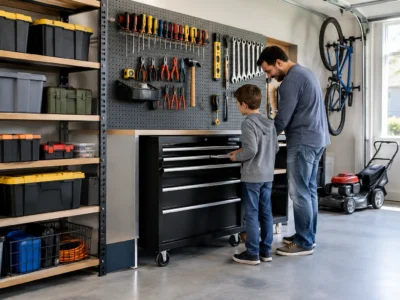
A drill buried under soccer gear, a ladder leaning in the corner, and a drawer full of loose sockets make even a well-equipped garage harder to use. The best ways to store tools are not about hiding everything away. They create a clear, durable system that keeps the tools you reach for accessible, protects the equipment you use less often, and leaves room for family life.
For most homeowners, the right solution combines enclosed cabinets, wall-mounted organization, a dedicated work surface, and elevated storage for bulky items. When each category has a defined home, projects start faster, cleanup is simpler, and the garage feels like a finished extension of the house rather than a catch-all room.
Start by Sorting Tools by How You Use Them
The first decision is not where a tool should go. It is how often you need it. Frequently used hand tools, measuring tools, chargers, and basic supplies should be close to your main work area. Seasonal equipment, specialized power tools, and project-specific supplies can be placed higher or farther from the daily path.
A practical garage organization plan usually separates tools into three working groups: everyday tools, project tools, and long-term equipment. Everyday tools include the items you use for quick household repairs. Project tools might include a sander, nailer, saw, or painting equipment. Long-term equipment may include bulky cases, specialty tools, and items used only once or twice a year.
This distinction prevents a common problem: placing every tool in the same cabinet or bin simply because there is open space. A system works best when it reflects your actual routines. If you need a screwdriver for a loose cabinet pull, you should not have to move camping equipment to find it.
Best Ways to Store Tools With Garage Cabinets
Premium garage cabinets are often the foundation of tool organization because they protect equipment from dust, visual clutter, and accidental access by children. They also create a clean, finished appearance that open shelves and mismatched containers rarely provide.
Base cabinets are ideal for heavier tools and supplies. Their lower position makes them convenient for tool cases, power tools, paint supplies, and hardware organizers. A durable countertop above the cabinets creates a reliable place to set down a project, charge batteries, or handle small repairs without taking over the kitchen table.
Tall cabinets provide valuable vertical capacity for items that do not fit neatly in a drawer or on a wall. Extension cords, yard equipment, long-handled tools, shop vacuums, and larger cases can be stored behind closed doors while remaining easy to access. For households with children, lockable cabinet options can add another layer of safety for sharp tools, chemicals, and equipment that should not be handled without supervision.
Cabinets are particularly valuable when appearance matters. They allow a family to keep the garage looking orderly even when life is busy and a project is still in progress. The trade-off is that cabinets should be thoughtfully designed. A cabinet that is too deep, too high, or packed without categories can become another hard-to-search hiding place.
Use Drawers for Small Tools and Hardware
Drawers make the most sense for the tools that tend to disappear in large cabinets. Screwdrivers, pliers, wrenches, utility knives, drill bits, tape measures, batteries, and fasteners are easier to find when stored in shallow, organized drawers.
Group tools by task rather than by whatever happens to fit. Keep measuring and marking tools together, place fastening tools near screws and anchors, and reserve another drawer for electrical repair supplies. This approach reduces duplicate purchases and makes it easier to put everything back after a project.
Put Frequently Used Tools on a Slatwall System
A slatwall system is one of the most efficient ways to keep commonly used tools visible without leaving them scattered across a workbench. With purpose-built hooks, baskets, shelves, and holders, tools can be arranged at eye level and adjusted as your needs change.
This is especially useful for rakes, shovels, brooms, extension cords, hoses, and other awkward items that consume floor space when they lean against a wall. A well-planned wall system keeps handles secure, creates clear separation between items, and makes it obvious when something has not been returned.
For hand tools, a smaller section near the workbench can hold the items you use most. There is no need to display every tool you own. Reserve wall space for tools that benefit from quick access, while keeping specialty items protected in cabinets. That balance gives you convenience without making the garage feel visually crowded.
Use Overhead Racks for Bulky, Infrequently Used Items
Overhead storage racks are not the place for daily-use tools, but they are highly effective for freeing up floor space around them. Tool cases, empty project containers, seasonal maintenance supplies, and lightweight equipment can be stored above the active area of the garage.
The key is to avoid treating elevated racks as a place for random overflow. Items placed overhead should be clearly labeled, safely contained, and light enough to retrieve comfortably. Keep heavy tools and anything you need regularly at a lower, more accessible height.
A professionally designed overhead system helps ensure that racks are positioned around vehicle clearance, ceiling height, lighting, and the overall traffic flow of the garage. This matters because useful storage should never make parking, walking, or reaching other equipment more difficult.
Build a Work Zone That Supports Real Projects
A dedicated workbench changes how a garage functions. Instead of setting tools on the floor, balancing materials on a folding table, or starting a repair wherever there is room, you have a stable area designed for the task.
The most effective work zones place a durable countertop within reach of drawers, cabinets, and wall-mounted tools. Chargers can have a designated location, small parts can stay contained, and tools can be returned immediately when the work is done. Families who enjoy home repairs, crafts, bike maintenance, or weekend projects benefit from having one dependable place to work.
Consider the kind of projects your household actually does. A homeowner who handles occasional repairs may need a compact bench with efficient drawer storage. Someone who regularly works on hobbies or equipment may need more counter space, brighter task lighting, and greater clearance around the work area. The best layout depends on the work, not on a one-size-fits-all setup.
Protect Tools From Damage and Safety Risks
Good tool storage protects your investment as well as your family. Moisture, extreme garage temperatures, dust, and clutter can shorten the life of batteries, metal tools, and precision equipment. Enclosed cabinets help shield sensitive items, while proper wall holders prevent long-handled tools from falling or warping.
Keep sharp-edged tools secured and out of reach of young children. Store chemicals separately from tools, and avoid placing heavy equipment on high shelves where lifting becomes unsafe. Power tool batteries and chargers should have a dry, orderly location away from loose hardware and household clutter.
It is also wise to leave open floor space around the work zone and walking paths. A garage should support vehicles, hobbies, household storage, and family activity without creating trip hazards. Clear pathways are not wasted square footage. They are what make an organized garage practical every day.
Choose a System Designed Around Your Garage
The best ways to store tools work together as a complete system. Cabinets handle concealed organization, slatwall keeps active tools accessible, overhead racks reclaim unused height, and a workbench gives projects a permanent home. When these elements are designed around the dimensions of your garage and the equipment you own, every square foot has a purpose.
Professional garage organization also removes the guesswork from placement, capacity, and installation. Garaginization designs premium systems for homeowners who want durable materials, polished results, and a one-time investment in a garage that works harder for the whole family.
A tool should be easy to find, easy to return, and stored safely until you need it again. Start with the tools that create the most daily frustration, then build a system that gives your garage room to support the life happening around it.
 Garage Shelving for Overflow Storage That Works