
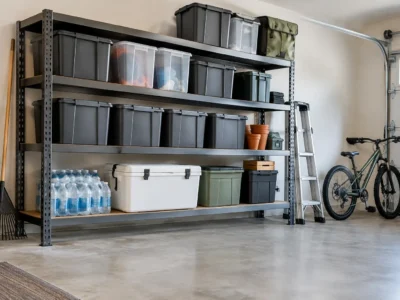
The items that overflow into a garage are rarely junk. They are the things a busy household needs, just not every day: holiday bins, team sports equipment, camping supplies, bulk paper goods, paint, tools, coolers, and the boxes you are not ready to part with. Garage shelving for overflow storage gives those belongings a permanent home without turning the garage into a wall-to-wall obstacle course.
The difference is not simply adding more shelves. A well-designed system puts the right items at the right height, supports real household weight, and leaves clear floor space for vehicles, projects, and daily movement. When shelving is planned around how your family actually lives, the garage becomes a useful extension of the home rather than a holding area for everything that does not fit inside.
Why Overflow Storage Needs a Real Plan
Overflow storage tends to grow quietly. A few seasonal tubs become a stack of bins. Sports gear migrates from the entryway to a corner of the garage. A warehouse-store run leaves extra cases of supplies with no assigned location. Before long, the items you use only occasionally are blocking the things you use every week.
Freestanding storage units can appear to solve the issue at first, but they often create a second problem: limited capacity, inconsistent dimensions, and crowded walkways. If shelves are too shallow, larger bins hang over the edge. If they are too deep, smaller items disappear behind larger ones. If the system is not rated for the weight it carries, safety becomes a concern.
Professional garage shelving is designed around the room, the contents, and the available footprint. It makes use of wall space that often goes underused while preserving the open floor area that makes a garage feel clean and functional.
What Belongs on Garage Shelving for Overflow Storage?
The best candidates are durable items that are used periodically and can be stored in labeled containers or grouped by category. This includes seasonal decor, household backstock, camping and outdoor gear, coolers, cleaning supplies, garden accessories, luggage, and hobby materials.
Shelving also works well for gear that needs to be visible. A family should be able to see where the soccer bag, folding chairs, picnic supplies, or pool accessories belong and return them without creating another pile. Open shelving provides that at-a-glance access, especially when storage bins are consistent in size and clearly labeled.
Some items deserve a different storage solution. Heavy, awkward belongings may be better suited to overhead racks, while chemicals, sharp tools, and items that should stay out of a child’s reach are better stored in lockable cabinetry. The goal is not to force every item onto a shelf. The goal is to create a complete storage system where each category has a safe, sensible place.
Store by frequency, not just by category
A practical shelving layout starts with how often an item is used. Keep weekly and monthly essentials between knee and shoulder height, where they can be reached without bending, climbing, or moving other items. Place seasonal and long-term storage higher up. Heavier containers should stay on lower shelves, both for safety and easier handling.
This simple approach prevents a familiar frustration: having to unload half a shelf to reach one item in the back. The more accessible the system is, the more likely every member of the household is to use it correctly.
Capacity and Construction Matter More Than Appearance Alone
A polished garage is a major benefit, but overflow storage asks shelving to perform. Household storage bins can become surprisingly heavy when filled with books, keepsakes, tools, or seasonal decor. Cases of bottled water, automotive supplies, and outdoor equipment add up quickly as well.
That is why shelving should be selected for its load capacity, mounting method, and long-term durability, not just its price tag or visual appeal. Premium wall-mounted shelving keeps stored items off the ground and creates a cleaner, more intentional look. Heavy-duty materials and professional installation help ensure the system remains secure under daily family use.
The right shelf depth also matters. Shallow shelves are useful for paint, cleaners, small tools, and frequently used supplies. Deeper shelves accommodate standard storage totes and bulky equipment, but need thoughtful organization so items do not get buried. Many garages benefit from a mix of depths rather than one uniform shelf across every wall.
Plan for the climate inside your garage
Garages in Dallas-Fort Worth, San Antonio, Las Vegas, Atlanta, and Orlando can experience significant heat, humidity, dust, or temperature swings. Those conditions affect what should be stored and how it should be protected.
Use durable, lidded containers for fabrics, paper goods, keepsakes, and seasonal decorations. Avoid storing temperature-sensitive items, food, or anything that can deteriorate in high heat or moisture. A professionally designed system can also place storage away from areas more likely to collect dust or experience changing conditions.
Build a Layered Storage System, Not a Single Wall of Shelves
Shelving is highly effective, but it performs best as part of a coordinated garage organization plan. A wall of shelves can handle the family’s bins and household reserve supplies. Overhead storage can take care of the items used once or twice a year. Cabinets can conceal visual clutter and protect supplies that should be secured. Slatwall can organize items that are difficult to stack, such as hand tools, sports accessories, and outdoor equipment.
This layered approach gives the garage room to breathe. Instead of filling every shelf with unrelated belongings, you can assign each zone a clear purpose. The result is faster retrieval, easier cleanup, and a garage that feels finished rather than crowded.
For example, one family may dedicate shelving near the entry into the home to bulk household supplies and school-related items. Another may use a shelving zone near the vehicle parking area for weekend recreation, with camping bins above and everyday equipment at a reachable level. Neither layout is universally right. The best design reflects the routines, storage volume, and priorities of the people using it.
Common Mistakes That Waste Valuable Garage Space
Overflow storage fails when it becomes unplanned storage. The most common issue is keeping containers that are unlabeled, mismatched, or too heavy to move safely. Another is storing items by where there happens to be room instead of by how they are used.
It is also easy to overlook the value of clearance. Shelves should not interfere with vehicle parking, walking paths, or access to the areas you use most. A system that technically holds more belongings but makes the garage harder to navigate is not an improvement.
Finally, do not design only for what you own this week. Families change. Children move through new sports and activities, hobbies expand, and seasonal needs shift. Well-planned shelving should provide enough capacity to accommodate normal growth without encouraging clutter to return.
The Advantage of Professional Garage Design
A consultation brings a trained eye to storage challenges homeowners see every day but may not know how to solve. A professional designer can assess the wall space, ceiling height, vehicle clearance, household inventory, and desired aesthetic before recommending a system.
That process is especially valuable when overflow storage includes a combination of heavy bins, sports gear, tools, outdoor equipment, and long-term household items. Rather than relying on a one-size-fits-all layout, Garaginization designs and installs high-capacity storage systems that match the garage and the family who uses it. The result is a one-time investment in order, safety, and everyday convenience.
A garage should not require a scavenger hunt every time you need a cooler, a holiday tote, or an extra case of supplies. With shelving that is properly planned, professionally installed, and built for real household use, overflow storage stops taking over the garage and starts supporting the way your family lives.
 What You Need to Know About Custom Garage Cabinets Before You Start Shopping