
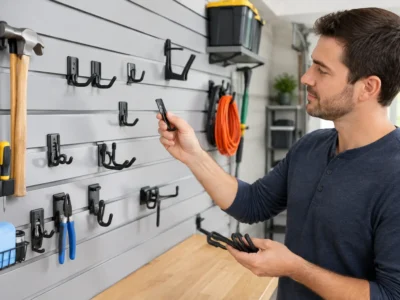
A slatwall system only works as well as the accessories attached to it. The wrong hook can leave a bike unstable, a ladder difficult to reach, or a favorite tool sitting back on the floor. Knowing how to choose slatwall hooks helps turn an attractive wall system into dependable, everyday storage that supports the way your family actually uses the garage.
The best choice is rarely one hook style repeated across the wall. A well-planned garage uses different hooks for different shapes, weights, and access needs, then places them where each item can be returned without effort. That is what keeps a garage organized after the initial transformation is complete.
Start With What You Need to Hang
Before comparing hook styles, take inventory of the items currently leaning in corners, crowding work surfaces, or taking up valuable floor space. Most homeowners need a mix of storage for hand tools, yard equipment, extension cords, folding chairs, sporting goods, bicycles, and seasonal gear.
Pay attention to each item’s shape as well as its weight. A lightweight tennis racket and a lightweight garden hose may weigh about the same, but they need very different support. The racket benefits from a narrow, shallow hook that keeps it visible and easy to grab. A hose needs a wider hook or cradle that prevents kinking and keeps the coil from slipping off.
Think about how often each item is used. Frequently used equipment should be positioned at a comfortable reach height, generally between waist and shoulder level. Occasional items can go higher, while heavy objects should stay lower for safer lifting and easier return.
How to Choose Slatwall Hooks by Type
Slatwall hooks come in a range of profiles, and each serves a practical purpose. Choosing by appearance alone often leads to crowded walls and accessories that do not adequately support the load.
Single hooks work well for lighter, compact items such as hand tools, small bags, cords, and protective gear. They are useful in groups, especially near a workbench or a family drop zone, but they are not the best choice for long-handled tools or bulky sports equipment.
Double hooks provide more stability and carrying area. They are a smart option for shovels, rakes, leaf blowers, trimmers, folding chairs, and other items that can twist or slide when supported by one contact point. The second prong helps distribute the load and holds equipment closer to the wall.
J-hooks and utility hooks are designed for larger items with a handle, frame, or broad tube. These are common choices for ladders, wheelbarrow handles, hoses, and larger yard equipment. Look for a deep enough curve that the item cannot roll or bounce out when the garage is busy.
Specialty hooks and cradles are worth considering for items that are awkward, expensive, or used often. Bicycle hooks, ball storage accessories, fishing rod holders, and golf bag supports can make a major difference for active families. A purpose-built accessory usually protects the item better than trying to make a general hook do a job it was not designed to do.
Match the Hook to the Slatwall System
Not every hook fits every slatwall panel. This is one of the most overlooked details when homeowners purchase accessories separately. Slatwall systems vary in slot dimensions, panel thickness, locking mechanisms, and material construction. A hook that seems to fit may sit loosely, shift under weight, or fail to engage as intended.
Choose accessories made for your specific slatwall system whenever possible. Premium hooks typically have a formed metal backplate or a secure locking feature that seats firmly in the channel. This connection matters more as the load becomes heavier or the item is frequently removed and replaced.
Material quality also affects long-term performance. Garage environments can experience heat, humidity, dust, and changing temperatures. Powder-coated steel hooks are a strong choice for many applications because they resist corrosion and provide dependable support. Protective rubber or vinyl coatings are especially valuable for bicycles, finished tools, and equipment that could be scratched by bare metal.
Check Capacity, Then Consider Real-World Use
Weight capacity is a key factor, but it should never be considered in isolation. The rating may apply to the hook itself, while the actual safe load also depends on the slatwall panel, the wall behind it, and the quality of the installation.
For example, a heavy-duty hook may be rated to hold a substantial amount of weight, but a long ladder creates leverage as it extends away from the wall. That leverage puts more stress on the hook and the panel than a compact item of the same weight. Bulky equipment may also be pulled down at an angle rather than lifted straight up, adding force to the connection.
Give heavy items a margin of safety. Do not select a hook whose listed capacity barely matches the item’s weight. Consider the load when the item is wet, packed with gear, or handled by a child who may pull from the side. For especially heavy or oversized belongings, professional design guidance helps ensure the wall system and accessory placement are appropriate for the job.
Plan Spacing Before Filling the Wall
A wall full of hooks can look organized at first but still be difficult to use. The goal is not to hang every item as tightly together as possible. It is to create clear zones where equipment can be removed and put away without knocking into neighboring items.
Start with the largest pieces. Bikes, ladders, yard tools, and sporting equipment establish the spacing for the rest of the layout. Once those pieces have a home, smaller hooks can fill in open areas for cords, gloves, helmets, and hand tools.
Leave room for handles to move and for doors, drawers, cabinets, or vehicles to clear the stored items. Long-handled equipment often needs more horizontal separation than expected, particularly when several tools are stored side by side. Vertical space matters, too. A tool may fit on a hook but still be inconvenient if its handle extends into a walkway or blocks access to other storage.
For family garages, create intuitive zones. Keep sports gear near the vehicle parking area or the main exit, yard tools near where they will be carried outside, and project tools near the workbench. When storage follows daily routines, everyone is more likely to use it correctly.
Prioritize Safety and Accessibility
Hooks should hold items securely without creating new hazards. Avoid placing sharp tools, heavy objects, or long-handled equipment where they can be bumped by a car, snagged by a backpack, or pulled down by a child. Make sure each item is fully seated in the hook and that its weight rests against the wall rather than hanging outward.
Accessibility is equally important. Children should be able to return age-appropriate sports gear without climbing, stretching, or moving heavy equipment. Adults should not need to shift three items just to reach a leaf blower or a frequently used tool. A professionally designed slatwall layout accounts for these daily habits from the beginning.
Adjustability is one of slatwall’s strongest advantages. Family activities change, children grow, and seasonal equipment comes and goes. Choose a system with quality hooks that can be repositioned as your needs evolve, rather than locking the garage into a layout that only works for one season.
When Professional Planning Makes the Difference
Selecting individual hooks is simple when you have a few tools to hang. It becomes more complex when you are organizing an entire garage around vehicles, cabinetry, overhead storage, work areas, and an active family’s equipment. The best layout balances capacity, appearance, safety, and access without making the walls feel crowded.
Garaginization helps homeowners create finished garage systems where slatwall hooks are selected as part of a complete storage plan, not as an afterthought. With the right accessories in the right places, the floor opens up, everyday items stay within reach, and the garage feels like a useful extension of the home.
A thoughtful hook plan gives every piece of gear a clear destination. When putting something away is easier than leaving it out, a clean, functional garage becomes the natural result.
 How to Create Garage Zones That Work Harder