

Quick Summary
- Most garage cabinet companies use 1099 subcontractors — meaning the person who sold you the job has zero control over who actually shows up to install it.
- Dallas garages face extreme heat and humidity that will destroy standard particle board and cheap hardware within a few years if you don’t know what to look for.
- This checklist gives you the exact questions to ask before you sign anything, so your investment outlasts the mortgage — not just the warranty card.
You’ve decided to stop tolerating the chaos. The bikes leaning against the wall, the tools piled on the floor, the boxes of things you haven’t touched in three years — it’s time to fix it. You’re ready to invest in a real garage cabinet system.
Here’s the part nobody tells you: choosing the wrong installer can cost you just as much as choosing no installer at all.
After 18 years in this industry, I’ve seen homeowners spend thousands on systems that warped, fell apart, or became impossible to get serviced — because they didn’t know what to ask before the job started. This checklist exists to make sure that doesn’t happen to you.
Know Your Installer: Why In-House W2 Teams Matter
This is the single most important question in the entire process, and most companies are hoping you won’t ask it.
Here’s how the franchise model typically works: a polished sales rep comes to your home, shows you beautiful renderings, and closes the deal. Then the job gets handed off to a 1099 subcontractor — an independent contractor who has no formal relationship with the company that sold you the system. The sales rep is gone. The manufacturer is separate. And the person drilling into your walls is accountable to no one but themselves.
When something goes wrong (and in that model, something eventually does), you’re left chasing three different entities, none of whom feel responsible.
At Garaginization, every single person who walks into your garage is a W2 employee — trained, vetted, and accountable to our dedicated W2 installation team. One company. One standard. Zero finger-pointing.
Ask every company you interview: “Are your installers W2 employees or 1099 subcontractors?”
If they hesitate, you have your answer.
The W2 vs. Subcontractor Reality Check
| W2 Employee Installer | 1099 Subcontractor | |
| Trained by the company? | Yes — to company standards | Not required |
| Background-checked? | Yes | Varies |
| Accountable if something goes wrong? | Company takes responsibility | Liability is murky |
| Consistent quality control? | Yes — same team, same process | No guarantee |
| Warranty backed by who? | The company you hired | Unclear |
This isn’t a minor operational detail. It’s the difference between end-to-end accountability and a handshake with a stranger.
What Your Dallas Garage Will Actually Put Those Cabinets Through
Before we talk materials, let’s talk about your environment — because most cabinet companies don’t.
A Dallas garage in July can hit 130°F. In the winter, it can drop to the teens. That’s a 100-degree swing, sometimes within the same calendar month. Add in the humidity that rolls in from the Gulf, and you have a testing environment that will expose every shortcut a manufacturer took.
Standard particle board swells. Cheap hinges seize or fail. Rail-hung systems that look great in a showroom start pulling away from the wall when loaded with actual gear.
Here’s what to look for in a cabinet system built for a Texas garage:
- Full-back construction — not rail-hung. Full-back cabinets anchor to wall studs at multiple points, distributing weight properly and preventing the “lean and gap” failure you see in big-box units.
- 1-inch shelving — not the 3/4-inch standard. The difference is dramatic when you’re loading it with tools, power equipment, or sports gear.
- Industrial-grade soft-close hinges — designed to handle thermal expansion and contraction without seizing. These aren’t a luxury feature in a Texas garage; they’re a structural requirement.
- Moisture-resistant finishes — because humidity doesn’t take a season off in DFW.
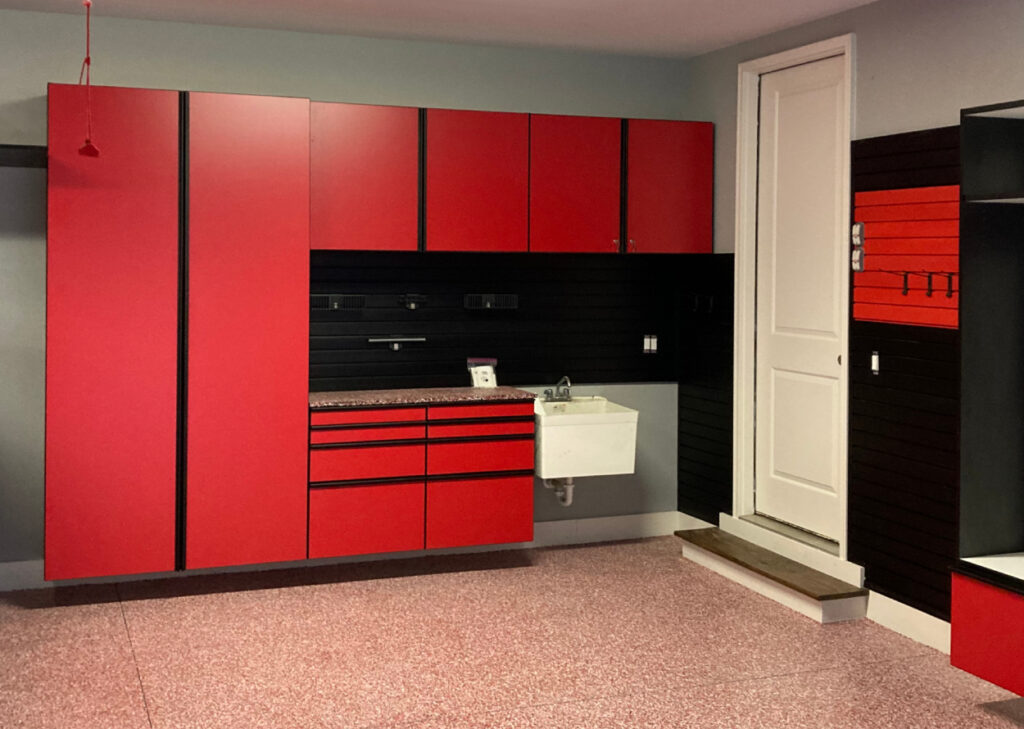
Our durable Classic Series cabinets are engineered to meet these specs as the accessible entry point into a real system. Our premium Signature Series options go further — full custom sizing, the widest finish range available, and hardware built for a lifetime of daily use.
The 3D Design Consultation: What It Should (and Shouldn’t) Look Like
A credible installer doesn’t guess. They measure, they plan, and they show you exactly what you’re getting before a single board is cut.
A proper custom 3D space planning consultation should produce a rendering of your specific garage — your dimensions, your storage needs, your lifestyle. If a company is showing you a generic catalog photo and asking you to “imagine it in your space,” that’s a red flag.
Ask these questions during the consultation:
- “Is this design specific to my garage’s exact measurements?” Generic modular systems are designed for speed, not fit. Custom sizing means no awkward gaps, no wasted wall space, and a system that actually works the way your life works.
- “Can I see a 3D rendering before I commit?” You should be able to see your finished garage before the install date. If they can’t provide this, ask why.
- “What happens if the final installation doesn’t match the rendering?” The answer to this question tells you everything about how much accountability is built into their process.
The Longevity Questions: Warranties, Business Tenure, and the “Who Backs This?” Test
A warranty is only as good as the company standing behind it. In a high-turnover service industry, that’s not a small caveat — it’s the whole ballgame.
Here’s what to verify before you sign:
How long has the company been in business? Garaginization has been serving DFW homeowners since 2008. We’ve maintained an A+ BBB rating for over a decade in an industry where most companies don’t survive five years. That longevity isn’t a footnote — it’s proof that our work holds up and our clients don’t come back with complaints.
What exactly does the warranty cover? Get it in writing. A lifetime warranty on shelving means nothing if the cabinet boxes aren’t covered separately. Ask for a breakdown: shelving, cabinetry, hardware, and installation labor.
What happens to the warranty if you sell the house? A truly permanent system should transfer. Our Monkey Bars shelving carries a lifetime warranty that stays with the system — not just the original owner. When you frame this installation as a home improvement investment (which it is), that transferability matters.
Your Pre-Hire Checklist: Questions to Ask Every Installer
Before you sign a contract with any garage cabinet company in the Dallas-Fort Worth area, run through this list:
Company Accountability
- Are your installers W2 employees or 1099 subcontractors?
- How long has your company been operating in the DFW market?
- Can you provide your BBB rating and any third-party reviews?
- Is your business locally owned, or are you a franchise operating under a national brand?
Materials & Engineering
- Do your cabinets use full-back construction or a rail-hung system?
- What is the shelf thickness, and what is the rated weight capacity per shelf?
- What hardware do you use, and how is it rated for temperature and humidity fluctuation?
- Are your materials appropriate for an unconditioned garage environment in Texas?
Design & Consultation Process
- Will I receive a 3D rendering of my specific garage before installation?
- Are your cabinets custom-sized to my space, or are they modular pre-fab units?
- Who handles the design, manufacturing, and installation — and are they all part of your company?
Warranties & Long-Term Value
- What does your warranty cover, and for how long?
- Is the warranty transferable if I sell the home?
- Who do I contact if there’s an issue after installation, and will it be the same company?
One More Thing Worth Knowing: The Diamond-Grind Standard
If your project includes an epoxy floor alongside your cabinet installation (and if you’re investing in the space, it should be on your radar), ask one more question: “Do you diamond-grind the floor before coating it?”
Most companies skip this step. It takes longer and costs more. Diamond-grinding opens the concrete’s pores at a mechanical level, creating a bond that lasts. Without it, the coating peels — sometimes within a year.
We diamond-grind every floor before we coat it. Always have since 2008. It’s the kind of detail that separates a permanent installation from a temporary fix.
Conclusion: The Right Installer Isn’t Hard to Find — If You Know What to Look For
Hiring a garage cabinet company isn’t complicated, but it does require asking the right questions. The difference between a system that outlasts the mortgage and one that starts failing in year three almost always comes down to two things: who’s actually doing the work and what they’re building it with.
You now have the checklist. Use it with every company you talk to — including us. We’re confident in what the answers will reveal.
If you’re ready to see what your garage could look like, let’s start with a [custom 3D space planning] consultation. We’ll design your space, show you exactly what you’re getting, and walk you through every material and hardware decision before a single board is cut.
Garaginization has been serving DFW homeowners since 2008. No franchises. No subcontractors. No shortcuts.
Schedule Your Free 3D Design Consultation →
Frequently Asked Questions
How does the use of 1099 subcontractors versus W2 employees impact the quality and accountability of a garage cabinet installation?
When a company uses 1099 subcontractors, the sales team, manufacturer, and installer are three separate entities with no shared accountability. If something goes wrong — a misaligned cabinet, a warranty issue, a damaged wall — there’s no single point of responsibility. W2 employee installers, by contrast, are trained, managed, and accountable to the company that sold you the job. That continuity is what makes end-to-end accountability possible. At Garaginization, every installer is a W2 employee. That’s not a policy we advertise — it’s the foundation of how we operate.
Why is full-back cabinetry construction critical for storing heavy tools and sports equipment compared to standard rail-hung systems?
Rail-hung systems attach to the wall at a single horizontal rail, concentrating all load stress at one anchor point. Under the weight of heavy tools, power equipment, or sports gear, that stress causes the system to pull away from the wall over time — especially in an unconditioned garage subject to thermal expansion. Full-back construction anchors to wall studs at multiple points across the entire back panel, distributing weight evenly and creating a structurally permanent installation. Combined with 1-inch shelving (versus the standard 3/4-inch), the load capacity difference is significant.
What specific hardware modifications are necessary for garage cabinets to withstand the extreme temperature and humidity fluctuations in Texas garages?
Dallas garages can experience temperature swings of 100°F or more across a single year. Standard cabinet hinges are not engineered for that level of thermal expansion and contraction — they seize, warp, or fail. Industrial-grade soft-close hinges, rated for high-heat and humidity environments, are the minimum standard for an unconditioned Texas garage. Additionally, moisture-resistant finishes on cabinet surfaces prevent the swelling and delamination that standard finishes experience under Gulf humidity. These aren’t upgrade options — they’re baseline requirements for a system built to last in DFW.
 The Hidden Costs of DIY Garage Shelving: What You’re Really Paying