
Quick Summary
- The “cheap” DIY garage shelf isn’t cheap — once you factor in lumber volatility, specialized tools, wasted materials, and your own labor, the real cost is often 60–80% of a professional system.
- Extreme heat cycles and humidity in an unconditioned garage accelerate wood sag and fastener failure faster than most homeowners expect, turning a 3-to-5 year replacement cycle into a recurring expense.
- A professional-grade, lifetime-warrantied steel system — designed, manufactured, and installed by a local W2 crew — is a one-time investment. The DIY rack is a subscription you never signed up for.
That sagging shelf in your garage? It’s not just an eyesore. It’s a bill that keeps coming due.
Every week, our team gets called out to a home where the same story plays out: a homeowner spent a weekend — sometimes two or three — building wood shelves from big-box lumber. The shelves looked fine at first. Then came a brutal summer. Then a wet winter. Then the slow, inevitable bow in the center of that plywood span, followed by the day everything came down.
We’ve seen it hundreds of times since 2008. And the number that surprises people most isn’t the cost of the professional system they eventually buy. It’s the total they’d already spent getting to that moment.
Let’s walk through what that actually looks like.
The “Cheap” Shelf Isn’t Cheap: The Real Material Cost
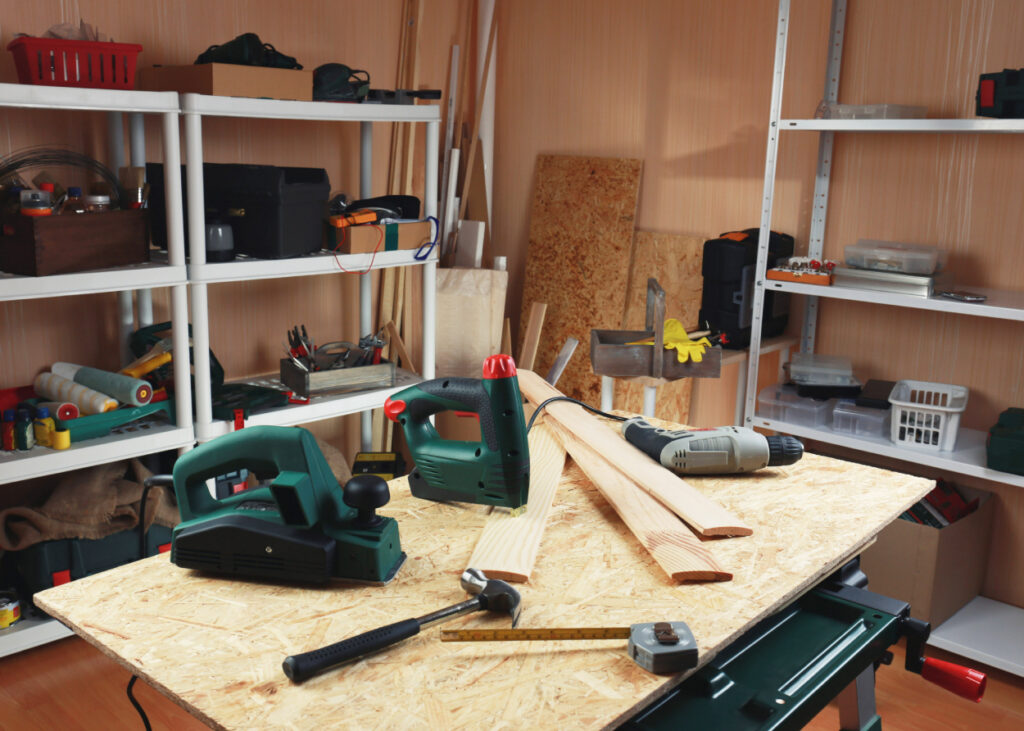
The mental math most homeowners do goes something like this: a sheet of plywood, a few 2x4s, some lag bolts. Maybe $150, $200 tops. Project done.
Here’s what that math leaves out.
Lumber prices have been volatile for years. A single 4×8 sheet of ¾-inch plywood that cost $35 in 2019 has regularly hit $65–$80 at home improvement stores since then. You’ll need multiple sheets for a functional system. Add in the 2x4s, the structural screws, the wall anchors, the sandpaper, the stain or paint — and you’re already past $300 before you’ve cut a single board.
Then there are the tools. A proper shelf installation requires a miter saw, a stud finder, a level, an impact driver, and a drill. If you don’t own all of these, you’re either buying them, renting them, or improvising — and improvising is exactly how you end up with a shelf that isn’t level and anchors that miss the stud.
The average homeowner who doesn’t already own a full tool set spends $400–$700 in materials and tools on a first-time DIY shelving project. That’s before accounting for the miscuts, the extra hardware store trips, and the boards that split when you drove the screw too close to the edge.
What an Unconditioned Garage Does to Wood Shelving
Here’s something most DIY guides don’t tell you: your garage is not a conditioned space.
Depending on where you live, garages can swing from freezing winters to scorching summers — often hitting well above 100°F in the warmer months. Humidity fluctuates dramatically between seasons. That combination is brutal on untreated wood, and most DIY shelving uses exactly that.
Think of it like a sponge. Wood absorbs moisture when humidity rises and releases it when things dry out. Every cycle of expansion and contraction works against the structural integrity of the shelf. Over time, plywood delaminates. 2x4s warp. The screws that were once tight in the stud begin to work loose as the wood around them moves.
A properly built DIY wood shelf in an unconditioned garage has a realistic functional lifespan of 3 to 5 years before it begins to visibly sag, shift, or require reinforcement. After that, you’re either rebuilding or replacing.
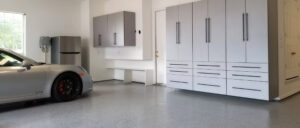
Engineered steel doesn’t do any of that. The systems we install are built from heavy-gauge steel — not the thin-wall wire rack material you find at retail, but structural-grade material with genuine load-bearing capacities that don’t change with the weather. The system you see on installation day is the same system you’ll see in 15 years.
The Anchoring Problem: When DIY Shelving Becomes a Safety Issue
This is the part of the conversation that matters most, and the part most blog posts skip.
Garage shelving fails in two ways: gradually (the sag you’ve been ignoring for months) and catastrophically (the collapse you didn’t see coming). The second kind is the dangerous one.
Proper anchoring requires locating studs accurately, using the correct fastener for the load, and understanding the difference between shear force and pull-out force. Shear force is what holds the shelf up. Pull-out force is what happens when the shelf tips forward under a dynamic load — like someone grabbing a heavy bin from the front edge.
Most DIY installations are anchored for shear. They’re not engineered for pull-out. When a shelf loaded with 200 pounds of seasonal storage tips forward, the result isn’t a gentle lean. It’s a sudden failure that can damage vehicles, injure people, and leave you with torn-out drywall and exposed studs.
Repairing drywall damage from a shelf collapse typically runs $300–$800, depending on the extent — and that’s before you buy new shelving.
Our professional installation team conducts a structural assessment before a single bracket goes into the wall. Every anchor point is located, verified, and installed to spec. No guessing. No “close enough.”
The Reconfiguration Problem: Fixed Shelves for a Changing Life
Here’s a hidden cost that doesn’t show up on any receipt.
The family that installs DIY shelves today is not the same family with the same storage needs four years from now. Kids’ gear changes. Hobbies evolve. You add a vehicle, a chest freezer, and a new set of bikes. The fixed wood shelf you built for one season of life doesn’t adapt to the next one.
Reconfiguring a DIY wood shelf means cutting new boards, adding new brackets, and patching the old anchor holes. It’s essentially a rebuild — and every rebuild resets the clock on that 3-to-5 year lifespan.
Modular steel systems adjust without any of that. Shelf heights move. Configurations change. The system grows with the household rather than fighting it.
The True Cost Comparison: One-Time Investment vs. Recurring Expense
Let’s put real numbers to this.
A mid-range DIY shelving project for a two-car garage — materials, tools, and your labor valued conservatively at $25/hour — lands somewhere between $600 and $1,100 for the initial build. Rebuild it once in year four: add another $400–$700. Factor in one drywall repair event: add $500. Over ten years, you’ve spent $1,500–$2,300, and you still don’t have a permanent solution.
A professionally installed Monkey Bars system — starting at ou raccessible entry point in the Classic Series — is a single line item with a lifetime warranty. No rebuilds. No drywall repairs. No annual “is this thing still safe?” inspection.
The math isn’t close. The DIY shelf is a subscription. The professional system is a permanent upgrade to your home.
What “Professional” Actually Means Here
We want to be direct about something: “professional installation” means different things to different companies.
At Garaginization, every installer is a W2 employee — not a subcontractor, not a day laborer dispatched from a third-party platform. Our team designs, manufactures, and installs every project under one roof. You get a 3D rendering of your new garage before we touch a single wall. You know exactly what you’re getting before the first bracket goes in.
We’ve been serving homeowners since 2008 with an A+ BBB rating and multiple Best of Houzz awards — in a service industry where most companies don’t last five years. That track record isn’t an accident. It’s the result of doing the job right, every time.
Conclusion: Stop Renting Your Storage Solution
The DIY garage shelf feels like a win on day one. By year two, it’s a problem you’re managing. By year four, it’s a project you’re redoing.
Homeowners who’ve been through that cycle once already know exactly what we’re talking about. The question isn’t whether a professional system is worth it. The question is how much more you want to spend finding out.
If you’re ready to stop renting your storage solution and start owning it, we’re ready to show you what your garage can actually become. Schedule a design consultation — no obligation, no pressure, just a clear picture of what’s possible.
Frequently Asked Questions
How do seasonal temperature swings and humidity in an unconditioned garage compromise DIY wood shelving?
Garages that aren’t climate-controlled experience significant temperature and humidity swings year-round. Untreated wood absorbs and releases moisture with each cycle, causing expansion, contraction, warping, and delamination over time. This cyclical stress weakens both the shelf material and the fasteners anchoring it to the wall. Most DIY wood shelving in an uninsulated garage has a realistic functional lifespan of 3 to 5 years before visible sagging or failure occurs.
What are the hidden financial consequences of improper stud anchoring during a DIY shelving installation?
Improper anchoring is the most common — and most expensive — DIY shelving mistake. When shelves are anchored to drywall instead of studs, or when the wrong fastener is used for the load, the result can be catastrophic shelf collapse. Beyond the cost of replacing the shelving itself, drywall repair typically runs $300–$800. If a vehicle or stored equipment is damaged in the collapse, costs escalate significantly. A structural assessment before installation eliminates this risk entirely.
How does the long-term ROI of a lifetime-warrantied steel system compare to the 3-to-5 year replacement cycle of DIY lumber shelving?
Over a 10-year period, a two-car garage DIY shelving system — accounting for the initial build, one rebuild, and a likely drywall repair event — typically costs $1,500–$2,300 with no permanent outcome. A professionally installed, lifetime-warrantied steel system is a single investment with no replacement cycle, no material degradation from heat or humidity, and no recurring labor cost. When the total cost of ownership is calculated honestly, the professional system wins by a significant margin.
 Why Your MDF Garage Slatwall Is Warping (And Why No Fix Will Save It)